A missed call is not the same as a lost job. Some callers are salespeople, some have the wrong number, and some will phone a competitor within minutes. The useful question is how many of the calls you miss are real customers, and what it would take to reach them.
This guide shows how to design a follow-up process for missed calls, step by step, and how to measure whether it pays for itself. The figures in the worksheet are invented examples. You will replace them with your own.
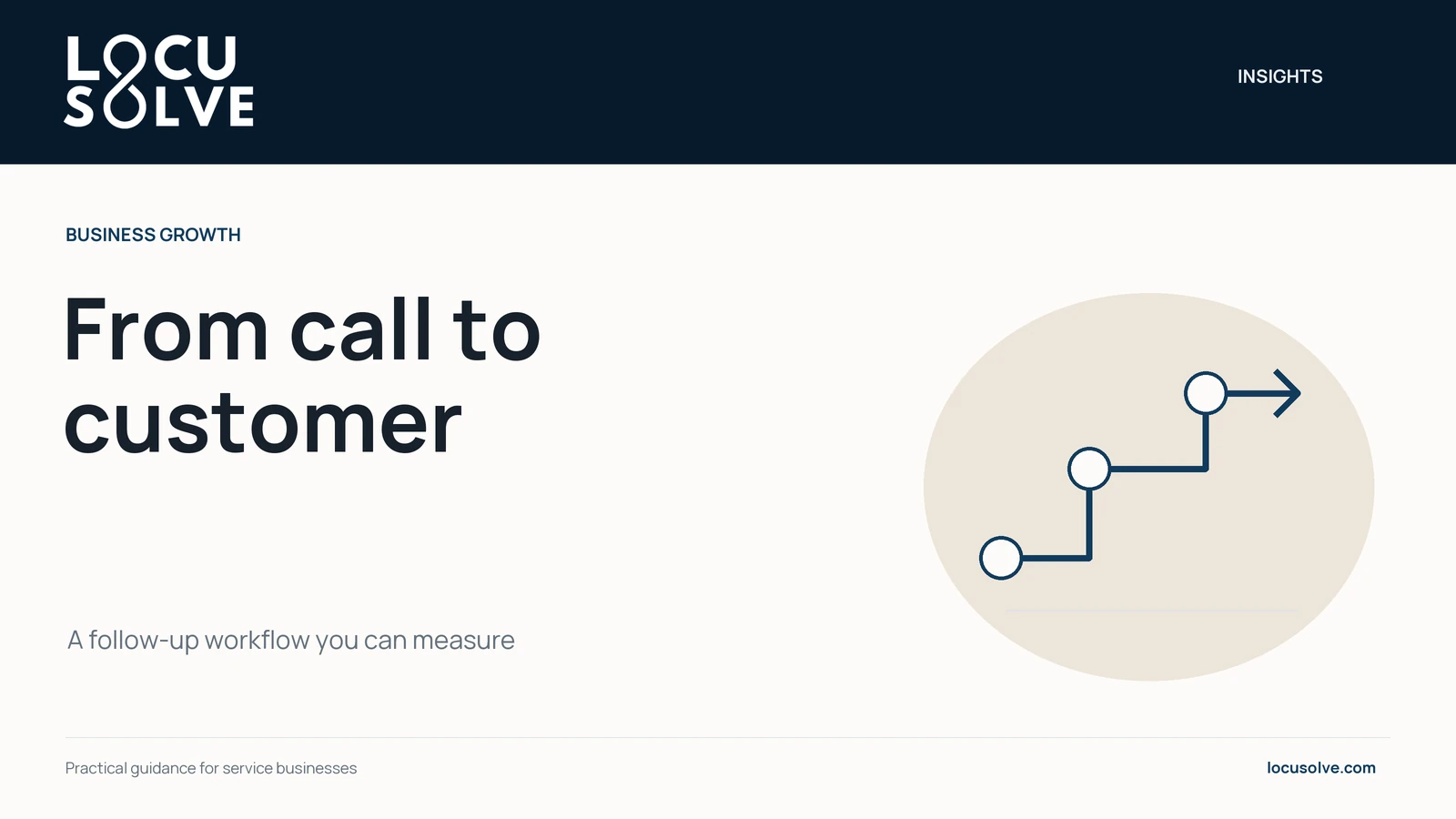
The workflow, from call to booking
Think of the process as six stages, each with a person who owns it.
Missed call
  1. Acknowledge   a short text or a note that the call was seen
  2. Call back     a person phones within a set time
  3. Quote         details gathered, price or visit agreed
  4. Confirm       booking confirmed in writing
  5. Record        outcome logged: booked, declined, no answer, not a customer
  6. Review        monthly look at the numbers
A text message is the first step, not the whole process. The goal is a conversation with a person, followed by a booking you can count.
Stage 1: Acknowledge the call
A missed-call text tells the caller, in effect, that you saw their call and will be in touch. Keep it short and honest. Do not promise a callback time you cannot meet.
What Canadian law says
In Canada, commercial text messages fall under Canada’s Anti-Spam Legislation, known as CASL. We are not lawyers, and this is not legal advice. Federal guidance and the Act say the following.
- CASL applies to texts. The federal government’s page on texting clients says texts need the same permission as other commercial electronic messages, your business name should be visible, and an opt-out such as replying STOP must be honoured.
- Section 6(1) of the Act prohibits sending a commercial electronic message unless the recipient has consented, expressly or impliedly. The message must also identify the sender, give contact information and include an unsubscribe mechanism.
- Whether a message is “commercial” turns on its content. Under section 1(2), it is if it is reasonable to conclude that one of its purposes is to encourage participation in a commercial activity.
- Section 6(6) lists some messages that do not need consent, including a quote or estimate that the recipient requested. Such messages still have to meet the form requirements.
- Implied consent is limited in time. The federal guide on getting consent says it generally lasts up to two years, or six months for an inquiry or application. It also says unsubscribe requests must be handled within 10 business days at no cost, and that you should keep records of consent.
Where that leaves a missed-call text depends on exactly what it says and on your relationship with the caller. A text that only says you saw the call and will phone back is different from one that advertises a service. We cannot tell you which side of the line your wording falls on, so ask a qualified adviser to review it before you send anything.
Stage 2: A person calls back
Decide who calls back, and by when. A realistic rule works better than an ambitious one. If your team cannot call back within an hour on a busy day, set the target at the end of the afternoon and say so.
Write down the exceptions as well.
- After hours. Send the acknowledgement, and put the callback on the next morning’s list.
- Emergencies. If your business takes urgent work, make the emergency number clear on your website and in your voicemail greeting.
- Existing customers. People already in a job should reach their project contact, not a general queue.
- Spam and wrong numbers. Create a quick way to mark these so they do not count as missed customers.
Stages 3 to 5: Quote, confirm and record
Write down what must happen at each stage and where the information goes. A shared spreadsheet is enough to begin. Record the date, whether the caller was a real prospect, whether you reached them, whether you quoted, whether they booked and the job value. If you use Google Analytics on your website, you can mark a form submission or booking as a key event, which is Google’s term for an action that matters to your business.
Without this record, you cannot tell whether the workflow works.
A worksheet with illustrative numbers
The numbers below are invented examples. They are not benchmarks and they do not describe any LOCUSOLVE client. Replace every assumption with your own measured figures.
| Step | Illustrative assumption | Result per week |
|---|---|---|
| Missed calls | 20 | 20 |
| Share that are real prospects | 60% | 12 |
| Share reached by a callback | 50% | 6 |
| Share that ask for a quote | 50% | 3 |
| Share of quotes that book | 40% | 1.2 jobs |
| Average job value | CAD 600 | CAD 720 |
| Gross margin on a job | 35% | CAD 252 |
Over four weeks, this example gives 4.8 jobs, CAD 2,880 in revenue and CAD 1,008 in gross margin.
Now subtract what you would have recovered anyway. If staff already return some of these calls, only the extra jobs count. Then subtract the cost of any tool, message fees and staff time. If what is left is small or negative, the workflow may not be worth it for your business yet, and that is a useful answer.
Use the calculator for a quick estimate
LOCUSOLVE’s Missed Call Revenue Calculator takes the number of calls you miss in a typical week, your average job revenue in Canadian dollars, the share of missed callers who would have booked and the share you could realistically win back. It shows missed revenue per year and a scenario table. The tool itself says that not every missed call is a lost customer, and that its figures are revenue rather than profit, so use it with the margin row above.
Do not treat every missed call as lost revenue
The most common mistake is multiplying all missed calls by the value of an average job. Many missed calls are not customers, and many customers would have called back or left a voicemail. The “real prospect” and “reached by a callback” rows correct for this. Your phone provider’s call log gives you real numbers to enter instead of guesses.
Where automation helps
Automation suits acknowledgement, logging and reminders, because those tasks repeat and follow rules. It suits judgement calls less, such as pricing an unusual job or handling an upset customer.
LOCUSOLVE builds follow-up workflows as custom scopes. Message rules, stop conditions, consent handling and usage costs are agreed in writing before work begins. If you would like to look at whether a missed-call workflow suits your business, our AI Sales & Automation service is the place to start, and a free consultation lets you describe how calls reach your team today.